After assessing business value, the Feature Hypotheses Simulation (FHS) decision path turns to risk. Jupyter Notebook 05 — Risk Resilience asks a critical question: which risk layer removes the most value from a roadmap candidate?
The mechanics are detailed in the Product Owner Case and the executable notebook. This post explains risk resilience from the Product Owner’s perspective.
Portfolio Risk
Extending the planning horizon by simulating a roadmap can add unnecessary complexity. That means simulating a roadmap over a year or more, makes no sense. Most companies must react and adapt very fast to changing conditions. A release cycle can be too far for it. The model uses a quarter as a release cycle.
| Horizon | Portfolio means | Risk question |
|---|---|---|
| Sprint | Items selected for the next Increment | What if one slice does not become Done? |
| Release | Features or Increments shipped together | What if dependency or market risk hits the bundle? |
| Roadmap | Candidate features across quarters | Which set keeps enough value under uncertainty? |
Portfolio risk refers to the risk associated with delivering, funding, or evaluating a group of Scrum Increments or features within a single planning horizon. These horizons are Sprints, Releases, and roadmaps.
Risk resilience means that a portfolio can cope with or recover from risks during planning. The key factor is the total risk of all selected features within a given period. Risks can affect single features or several at once, for example, if they depend on the same component or provider. Portfolio risk considers both individual and shared risks. The goal is to select features in a way that keeps the overall risk for the portfolio as low as possible.
Standard Risk
The approach defines three main risk types, analogous to financial risk.
- Market risk covers changes across the whole market, such as interest rate fluctuations, changing demand, new competitors, or new technologies in software development.
- Component risk involves platform risks that affect features or increments together. In software development, this includes security, platform issues, or problems delivering the portfolio to customers.
- Global risk refers to rare, severe, systemic shocks that affect everything, such as the 2008 financial crisis. Other examples include the energy and climate crises and pandemics.
This risk can affect development and delivery. In the worst case, it reduces business value and increases costs.
Delivery Risk
Delivery risk refers to the internal risks an organization faces in ensuring a product or service is delivered. The organization has full control over these risks. It is up to the organization and its third-party partners. It is the responsibility of the service delivery manager or the product owner.
The Likelihood of non-completion (LLP) is the probability that a feature will never go live. In each simulated scenario, an independent random draw from the feature’s LLP determines whether the feature is completed. If the feature is not completed, it generates no business value (BV), has zero revenue, no contribution margin, and all associated costs are fully sunk.
$$ \begin{gathered} \mathrm{BV}^{\mathrm{dev}}_i = \begin{cases} \mathrm{BV}^{\mathrm{sim}}_i, & \text{if completed} \\ 0, & \text{if not completed} \end{cases} \\ P(\text{not completed}) = \mathrm{LLP}_i \end{gathered} $$The main difference from Jupyter Notebook 06 is that Notebook 05 considers all risks collectively, including standard risks. Jupyter Notebook 06 focuses on development cost risk — how far the development bill can drift and which cancellation rule applies if a feature runs late.
Risk Waterfall
The risk waterfall illustrates the reduction in the estimated business value for each risk. It is presented in two diagrams: one for the overall portfolio and one for each feature.
The heat map combines portfolio data to compare development and market risks. For cases with low business value or varying market risks, it can help define boundaries for go/no-go decisions.
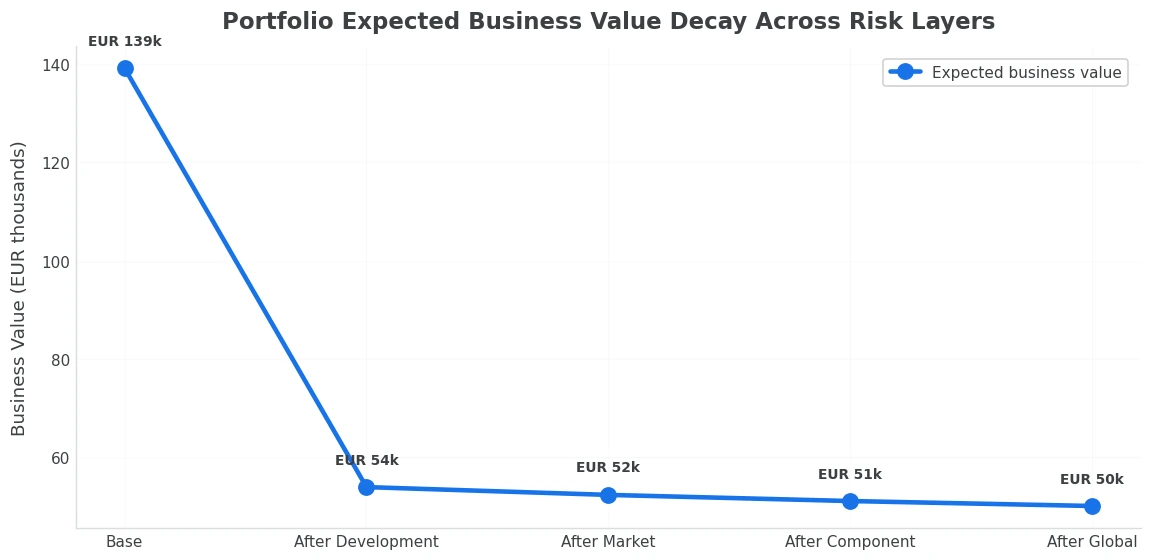
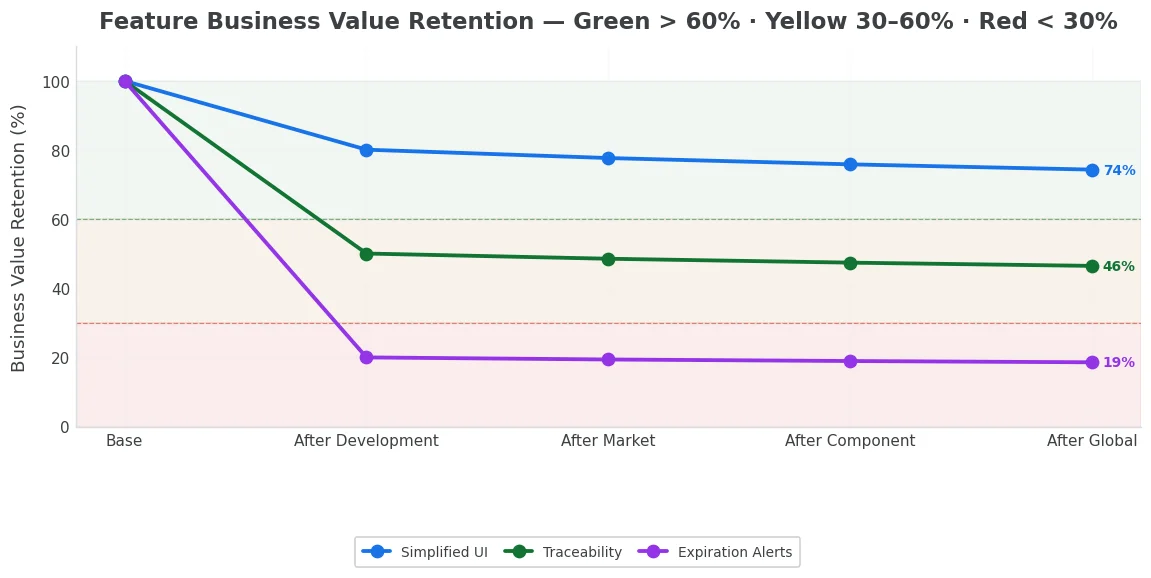
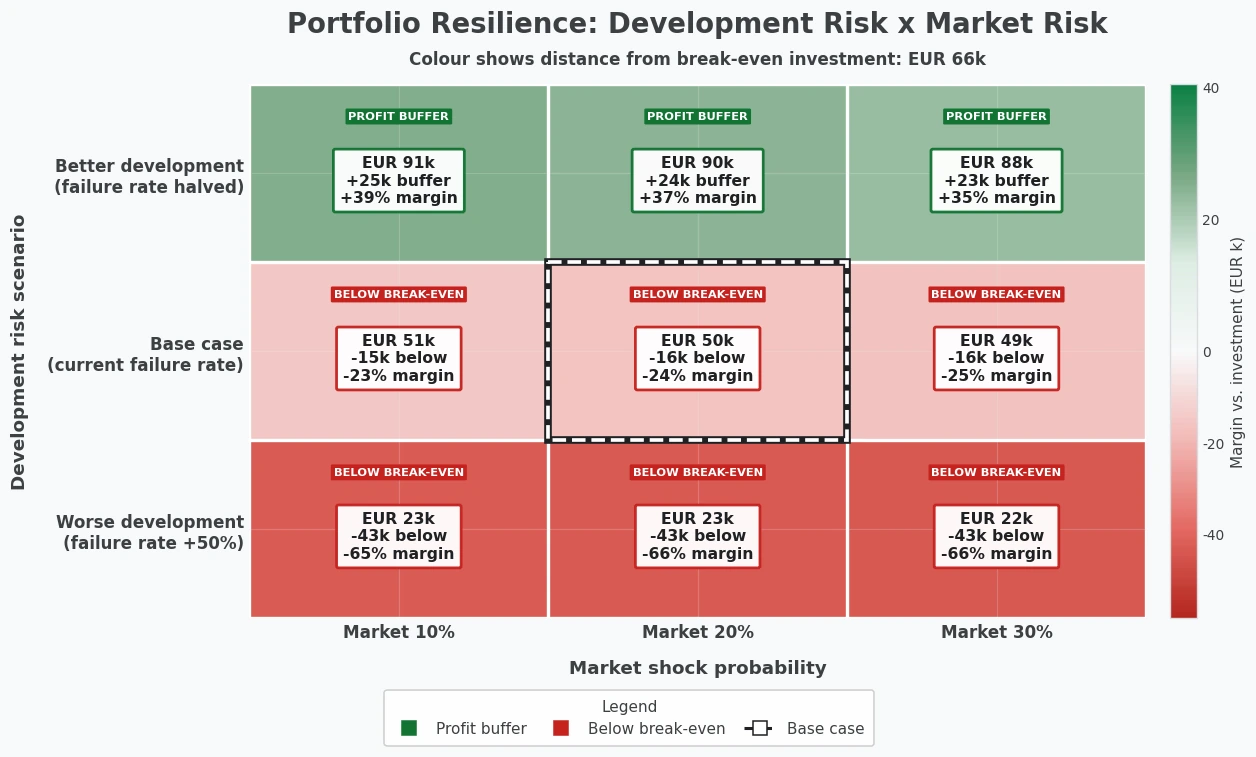
Source: Product Owner Case Study — Notebook 05.
Play with the simulation
Risk Resilience facilitates high-level decision-making and bolsters confidence in project financials. It empowers users and business representatives to leverage their expertise effectively. Sponsors, product owners, and service delivery managers can rely on it to substantiate decisions for company owners, managers, or shareholders.
It helps product owners and teams efficiently prioritize the backlog.
The Jupyter Notebook provides additional features and information beyond the introduction. I encourage you to explore the available simulations.
Information
- Reading guide — Notebook 05: Risk Resilience
- Executable notebook — 05: 05-blockchain-case-study-risk.ipynb
- Product Owner Case Study: six-step decision walkthrough
- Related post: Feature Hypotheses Simulation
- Related post: Business Value
- Related post: Development Risk